
Panduit Cable Cleats

Selling Guide

For power distribution cables laid on cable tray or strut, damage occurring from a short circuit fault is a serious but often overlooked and misunderstood issue. A short circuit fault can occur due to breakdown of equipment or conductors from deterioration, insulation failure due to lightning surges or overloading equipment, or something as simple as a vehicle accidentally backing into the cables.

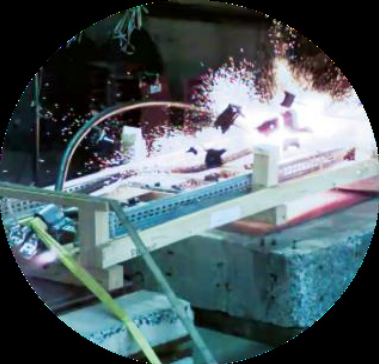
The result is “cable whipping,” an instantaneous and often very violent electromechanical repulsion of cables away from one another, resembling an explosion. This event damages the cable, cable tray, and potentially other equipment nearby.
Worst case scenario, people nearby get injured or killed. Cable cleats are tested and specified to restrain power cables during a short circuit fault, providing protection before a circuit breaker can react.

Effects of a Short Circuit Fault when cables are not properly restrained with the correct Cable Cleats.

Why Cable Cleats are Necessary

Electromagnetic force peak occurs at:

  • 5 ms on a 50Hz system (0.005 sec)
  • 4 ms on a 60Hz system (0.004 sec)

Circuit breakers and other protection devices trip at:

  • 0.06 sec to 0.1 sec

Cable Cleats perform their function immediately before peak kA is reached and before the fault protection devices can react and trip.

Panduit, a trusted Cable Cleat Manufacturer

  • All cable cleats are tested to the latest and most globally recognized cable cleat testing standard, IEC 61914:2015.
  • Offers patented mounting brackets with its strap cleats, providing installation flexibility on a variety of cable tray rung profiles.
  • Time and effort-saving mounting brackets for its Stainless Steel Trefoil (CCSSTR) and Aluminum Trefoil (CCALTR) cleats.

Panduit Cable Cleat Advantages

  • Engineering expertise and thought leadership
  • Award-winning multi-physics software that simulates short circuit forces on our cleats to help determine strength and functionality.
  • Product selector app (available now) and web tool provide calculations and cleat part and spacing recommendations at the touch of a fingertip.

Information Needed to Select a Cable Cleat:

1. Cable Outer Diameter (in) or (mm)
2. Peak Short Circuit Current (kA)
3. Cable arrangement:
     • Trefoil
     • Flat
     • Multicore
4. Type of Cable Tray being used:
     • Manufacturer
     • Part number
     • Material
     • Drawing
     • Rung dimensions

Scroll to Top